Excavation Estimating Services
ConstructQuant provides independent commercial excavation estimating services for excavation subcontractors, utility trenching contractors, and commercial general contractors across the United States. We examine architectural foundation plans, structural footing details, civil utility profiles, and geotechnical boring logs to model digging operations. Our takeoffs quantify basement mass cuts, foundation pad and continuous footing excavation, trench box shoring systems, rock mechanical hammering allowances, and off-site spoils haul logistics.
What Are Commercial Excavation Estimating Services?
Commercial excavation estimating is the technical analysis and production-based pricing of machine digging operations, soil removal, trench stability support, and spoils transport defined in CSI Division 31 23 00. Unlike broad site grading or earthwork volumetric balance, excavation estimating focuses on the physical production mechanics: hourly excavator bucket cycles, operator efficiency, depth de-rating factors, OSHA Subpart P protective shoring systems, rock fracturing techniques, and tight-access machine mobilization.
Basement & Foundation Excavation
Quantification of bulk basement cuts, access haul ramps, continuous wall footings, isolated column pads, grade beams, elevator pits, and formwork workspace over-excavation lines.
Trenching & Temporary Shoring
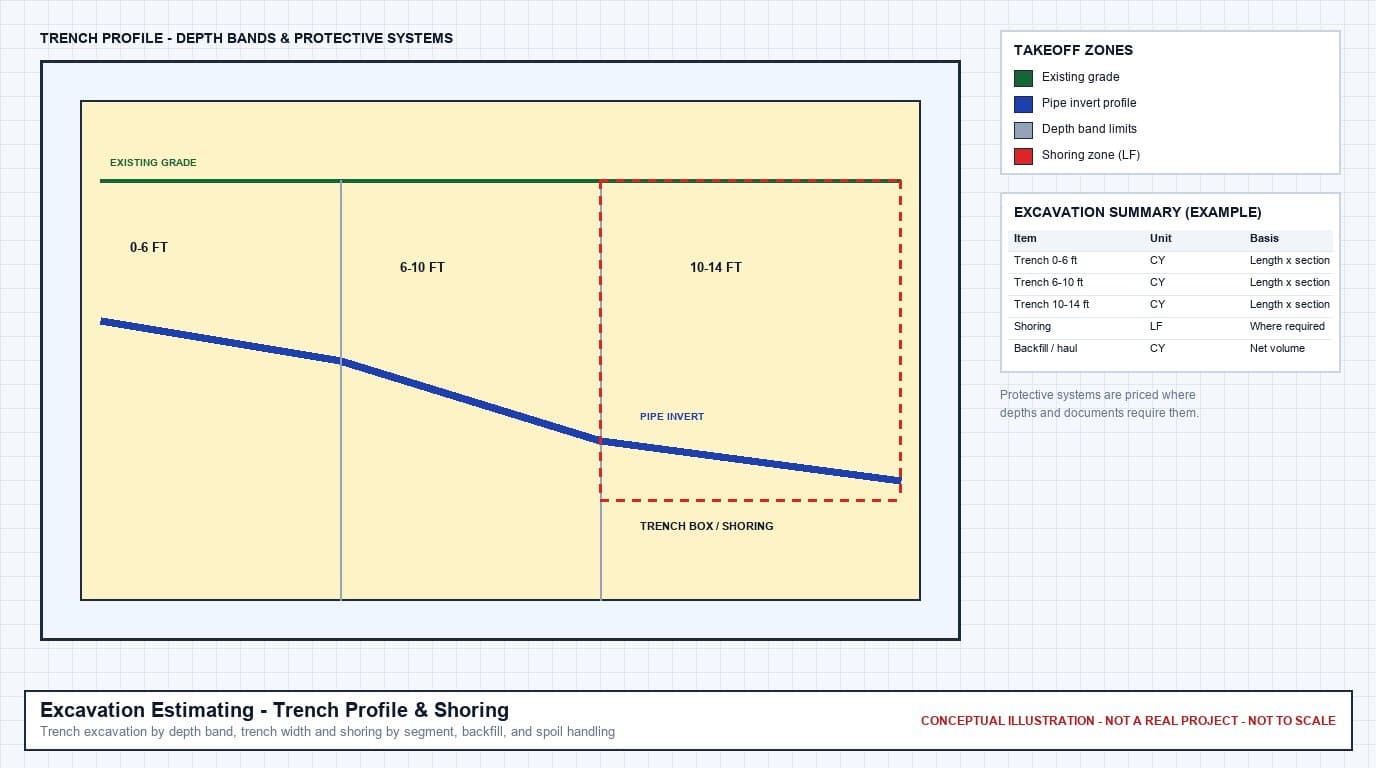
Measurement of utility trench cuts grouped by depth brackets (0'–6', 6'–10', 10'–14', 14'+), trench box rentals, hydraulic vertical shoring, slide rail systems, and steel sheet piling.
Rock Excavation & Obstructions
Modeling confirmed bedrock layers from soil borings: hydraulic breaker/hammer attachment hours, single-shank dozer ripping, controlled drilling/blasting, and rock trenching premiums.
Spoils Hauling & Backfill Cycles
Production modeling of excavator bucket cycle times, live loading into highway dump trucks, disposal tipping fees, imported granular pipe bedding, and mechanical trench compaction passes.
Example: Trench Excavation by Depth Band
Auditing deep utility trench cuts, trench box protective shoring, excavator cycle times, and spoils disposal hauling.
Comprehensive Commercial Excavation Scope Coverage
ConstructQuant models equipment production and digging operations across multi-story commercial basements, hospital expansions, and utility infrastructure corridors.
Building Substructure Digging
- Bulk basement cuts & underground parking excavation
- Excavation haul ramp construction and removal
- Continuous perimeter wall strip footing trenches
- Isolated column spread footing pad excavations
- Grade beam trenches & thickened slab edges
- Deep elevator pit and sump pit over-excavations
Utility Trenching Operations
- Storm drainage pipe trenching categorized by depth brackets
- Sanitary sewer deep trench excavation (down to 20'+ depths)
- Water distribution main trenches & service laterals
- Electrical conduit and telecommunications duct bank cuts
- Foundation workspace offsets (2-foot perimeter clearance)
- Trench bottom grading, hand-trimming & subgrade prep
Shoring & Excavation Safety
- Steel trench shields & manhole box rental modeling
- Slide rail modular trench shoring systems
- Aluminum hydraulic vertical shoring shores
- Soldier piles, wide-flange steel beams & wood lagging
- Interlocking steel sheet piling for water cutoff
- OSHA Type A, B, and C soil benching and slope laybacks
Rock & Obstruction Removal
- Bedrock excavation classified by geological stratum
- Hydraulic excavator hammer/breaker attachment machine hours
- Heavy tractor ripper shank passes in weathered shale/limestone
- Controlled pre-split drilling and blasting subcontract allowances
- Concrete foundation and footing mass demolition breaking
- Buried boulder and cobble handling production de-rating
Hauling & Spoils Disposal
- On-site excavator live loading into tri-axle dump trucks
- Truck travel cycle times based on round-trip mileage
- Commercial clean fill disposal facility tipping fees
- Contaminated soil handling & licensed landfill disposal
- Temporary on-site spoils stockpile management
- Street cleaning, wheel wash stations & track-out control
Bedding, Backfill & Compaction
- Imported crushed stone pipe bedding (#57, #8 stone)
- Pipe haunching and initial backfill shading zones
- Trench backfill placement in 8" to 12" loose lifts
- Flowable fill / controlled low-strength material (CLSM)
- Vibratory plate compactors, trench rollers & rammers
- Water table dewatering sump pumps & wellpoint systems
Excavation vs. Earthwork, Sitework, and Utilities
How excavation differs from earthwork, utilities, and sitework, the neighboring scopes within civil estimating.
Excavation Operations vs. Earthwork Estimating
Earthwork Estimating Services covers the whole-site 3D digital surface volume model: cut/fill quantities, geotechnical shrink/swell, site dirt balancing, topsoil stripping, and mass embankment compaction. Excavation Estimating focuses strictly on the operational digging mechanics: basement cuts, foundation footing trenches, trench box shoring rentals, excavator cycle times, bucket capacities, rock hammering, and trench backfill compaction.
Excavation Estimating vs. Utility Estimating
Excavation contractors frequently dig utility trenches for plumbing and utility subcontractors. However, excavation estimating strictly models the trench digging, shoring, bedding placement, and backfill. Our Utility Estimating Services page covers the complete utility piping system: pipe material procurement, valves, hydrants, sewer manholes, cleanouts, mandrel deflection testing, and pressure disinfection.
Excavation Estimating vs. Finished Sitework
Excavation delivers open cuts and compacted trench surfaces. Sitework Estimating Services covers the finished horizontal site improvements placed on top: crushed stone aggregate base courses, hot-mix asphalt paving, concrete barrier curbs, and pedestrian sidewalks.
Practical Estimating Realities in Commercial Excavation
Critical factors that govern heavy machine cycle times, operator efficiency, and trench safety costs.
OSHA Trench Safety & Shoring Depth Thresholds
OSHA Subpart P strictly requires protective shoring systems for all excavations 5 feet or deeper. A 12-foot deep sanitary sewer trench requires steel trench shields or modular slide rail systems, which add substantial equipment rental charges and reduce daily pipe laying rates by up to 40% compared to shallow utility cuts. Our takeoffs bracket every linear foot of trenching by depth so shoring costs are accurately captured.
Excavator Cycle Time & Bucket Swing Angle Modeling
Production is calculated using machine cycle times: dig time, swing loaded, dump into haul truck, and swing empty. A 90-degree swing cycle takes approximately 18 to 22 seconds, whereas a restricted 180-degree swing takes 28 to 32 seconds—reducing hourly output by over 30%. We adjust equipment production models based on site workspace layout, truck positioning, and machine class.
Rock Fracturing Production: Hammering vs. Ripping
Solid bedrock cannot be removed with a standard dirt bucket. When soil borings indicate refusal or rock with compressive strength exceeding 5,000 PSI, we model mechanical breaking using hydraulic hammers (e.g., Cat H160/H180 class) or dozer single-shank ripping. A 50-ton excavator with a hydraulic breaker typically yields only 15 to 30 cubic yards per hour, compared to 150+ yards per hour in clay.
Groundwater Dewatering & Trench Stabilization
Excavating below the seasonal groundwater table requires active dewatering (submersible trash pumps, trench sock drain lines, or wellpoint vacuum systems). Uncontrolled groundwater causes trench wall sloughing and unstable pipe subgrade, requiring additional crushed stone stabilization (#2 ballast rock) wrapped in geotextile fabric. Our takeoffs flag water table elevations from geotechnical logs.
Standard Commercial Excavation Deliverables
ConstructQuant provides clean, standardized preconstruction documentation tailored for excavation subcontractors and commercial builders.
1. Excel Estimate
Comprehensive cost workbook itemizing bulk basement cuts, footing trenches, shoring rentals, hammer attachment hours, haul trucking, and operator crew labor.
2. Excel Quantity Takeoff
Detailed excavation schedule organized by element (basement, footings, trenches by depth bracket), tabulating raw bank cubic yards and loose haul yards.
3. PDF Markups
Color-coded architectural foundation plans and civil utility sheets visually identifying footing cuts, trench depths, workspace clearances, and shoring runs.
4. Bid Summary
Executive summary breaking down total machine operating hours, heavy equipment mobilization expenses, spoils trucking allowances, and recommended bid-day markup margins.
5. Scope / Assumptions
Clear technical scope narrative recording soil classification (OSHA Type A/B/C), shoring assumptions, rock excavation clauses, dewatering inclusions, and addenda reviewed.
Our 6-Step Excavation Estimating Workflow
A disciplined, production-focused procedure ensuring complete trench depth analysis and equipment rate modeling.
Plans/Documents
Intake structural foundation plans, footing details, civil utility profiles, and geotechnical soil boring reports.
Scope Review
Identify foundation depths, groundwater tables, rock refusal elevations, OSHA soil types, and project addenda.
Quantity Takeoff
Quantify basement bulk cuts, footing volumes, trench lengths by depth bracket, and temporary shoring square footage.
Pricing
Apply excavator hourly operating costs, shoring box rentals, dump truck hauling rates, and disposal tipping fees.
QA/QC
QA/QC review checking footing over-excavation clearances, depth classification brackets, and cycle time rates.
Final Estimate Delivery
Deliver the final bid-ready Excel files, marked-up PDF foundation/trench plans, executive bid summary, and scope assumptions document.
Commercial Excavation Estimating Inquiries
Common preconstruction and technical questions answered for excavation subcontractors and commercial builders.
How do you calculate foundation over-excavation workspace allowances?
Foundation walls and basement concrete structures require exterior workspace for carpenters to set forms and install damp-proofing/drainage boards. We model a standard 2-foot to 3-foot horizontal workspace offset beyond the exterior face of footings, sloped back to satisfy OSHA trench safety standards. This prevents contractors from absorbing unbudgeted over-dig quantities.
How do you price rock excavation when bedrock is encountered?
Rock excavation is priced using two primary methods based on geotechnical boring logs: mechanical fracturing (hydraulic breaker/hammer attachment hours on 30-ton to 50-ton excavators) and controlled drilling/blasting. We establish a separate line item with designated unit pricing per cubic yard for mass rock and trench rock, ensuring subcontractors have clear contractual unit rate protection.
What is your turnaround time for an excavation estimate?
Turnaround is project-dependent. Deliverable timelines depend on foundation complexity, the linear footage of utility trenches across multiple depth brackets, whether temporary shoring systems must be modeled, and the clarity of geotechnical boring reports. We establish confirmed delivery milestones upon review of project plans.
Can you separate utility trench excavation from pipe installation?
Yes. Many excavation contractors provide "trench-only" subcontracts where they excavate trenches, supply/move trench boxes, and backfill after utility pipe is laid by mechanical or plumbing subcontractors. Our takeoff isolates trench volume, machine hours, and backfill materials, providing a standalone price schedule tailored for trenching subcontracts.
Integrated Preconstruction Estimating Services
Connect commercial excavation operations with adjacent earthwork, utility, and civil infrastructure packages.
Earthwork Estimating
3D surface cut and fill modeling, mass balance, geotechnical shrink/swell, and topsoil stripping.
Utility Estimating
Complete storm drainage, sanitary sewer, water distribution piping, and underground utility systems.
Sitework Estimating
Finished commercial site improvements, subgrade preparation, aggregate base, asphalt paving, and curbs.
Construction Estimating
Full-scope preconstruction cost modeling, quantity takeoffs, and trade package bid coordination.
Ready to Bid Your Next Commercial Excavation Project?
Send your structural foundation drawings, civil utility profiles, and geotechnical soil reports to ConstructQuant. Receive a line-item excavation takeoff and equipment cost model structured for competitive commercial bidding.