Government Construction Estimating Services
ConstructQuant provides paid, project-based estimating and quantity takeoff for contractors bidding government and public-sector building projects: municipal and civic buildings, public administration and public safety facilities, and modernization of existing public buildings. Estimates follow the bid documents, with the base bid, alternates, unit prices, allowances, and addenda reconciled to the bid form.
What Is Government Construction Estimating?
Government construction estimating is the quantity takeoff and pricing of publicly owned building projects, prepared to support a contractor's bid. Public projects are usually bid from a fixed package: a project manual with a bid form, drawings, specifications, and addenda. The estimate has to match that structure, pricing the base bid, each alternate, any listed unit prices, and the stated allowances as separate lines, and it must reflect every addendum issued before bid day.
Government & Civic Buildings
City halls, county administration buildings, courthouses, libraries, community centers, and other public administration and civic facilities.
Public Safety Facilities
Fire stations, police facilities, and emergency operations buildings, where apparatus bays, secure areas, and building systems are shown in the bid documents.
Public Facilities & Schools
Publicly bid school and educational facility work when it falls within the requested estimating scope, estimated from the same bid-document structure.
Renovation & Modernization
Modernization of existing public buildings, including selective demolition, system replacements, and phased work in buildings that stay in use.
Mapping Drawings to the Bid Form
On a public bid, the drawings show the work and the bid form shows how it must be priced. Alternate areas are quantified separately from the base bid, and every addendum is tracked against the lines it affects.
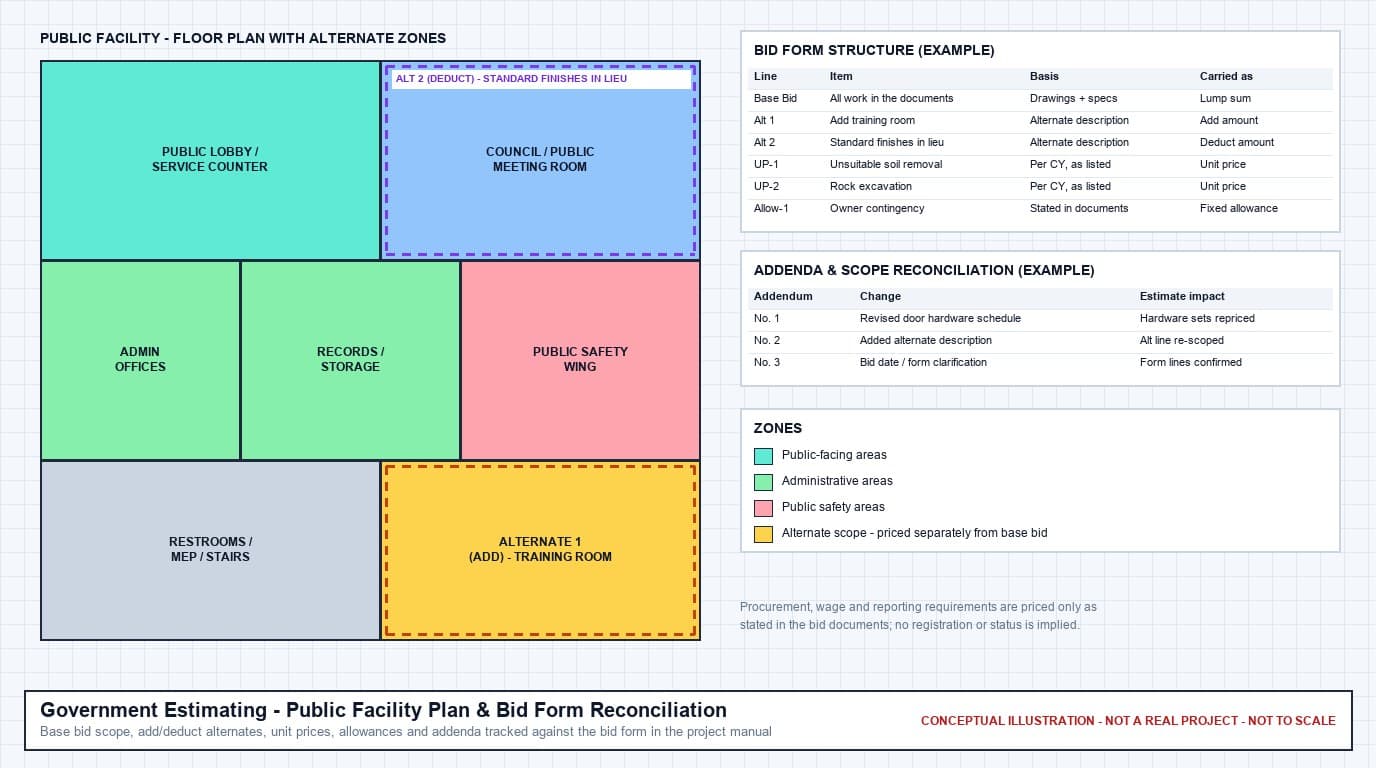
How Public Bid Documents Shape the Estimate
These elements come from the project manual and addenda. Each one is priced the way the documents define it.
Base Bid
All work shown in the drawings and specifications that is not separated out as an alternate, allowance, or unit price. The base bid is usually one lump sum on the bid form.
Alternates
Add or deduct changes described in the specifications, typically in an alternates section of Division 01. Each alternate is priced as its own line so the owner can accept or reject it.
Unit Prices
Prices per unit of measure for listed items, such as unsuitable soil removal or rock excavation, used when the final quantity is unknown at bid time. Priced only where the documents list them.
Allowances
Fixed amounts stated in the documents that bidders must carry, such as owner contingency or specific material allowances. They are carried exactly as stated, not re-estimated.
Addenda
Changes issued during bidding. Each addendum is logged, and affected quantities, alternates, and bid form lines are revised before the estimate is finalized.
Bid Requirements
Bonds, insurance, wage-rate schedules, and other procurement requirements are included as cost items only where they are stated in the project documents.
Division- and Trade-Level Estimating for Public Buildings
Public project manuals are usually organized by CSI MasterFormat division, so the estimate follows the same structure. That makes it easier to compare trade quotes against the specification sections they cover and to find gaps between trades.
Scope Reconciliation
Each specification section is assigned to a trade line in the estimate. Sections with no assigned trade, or scope claimed by two trades, are flagged so the bid team can resolve them before bid day.
Renovation of Occupied Public Buildings
Modernization of buildings that stay open to the public may require phased work areas, after-hours work, temporary partitions, and protection of public routes. These are priced as described in the documents.
Government vs. Commercial Construction Estimating
Government (This Page)
Publicly owned buildings bid from a fixed package. The estimate follows the bid form, with base bid, alternates, unit prices, allowances, addenda, and document-stated procurement requirements.
Commercial Construction
Privately owned commercial buildings such as offices and mixed-use projects, including core and shell vs. tenant improvement budgeting and negotiated or competitively bid work.
Public infrastructure outside buildings, such as roadways and utility networks, is covered under civil estimating.
Documents Reviewed for a Government Estimate
The project manual matters as much as the drawings. The bid form and Division 01 sections define how the work is priced.
- Project manual, including bidding requirements, the bid form, and instructions to bidders
- Division 01 general requirements, including alternates, allowances, unit prices, and phasing sections
- Technical specifications for every division in the project
- Architectural, structural, MEP, and civil drawings
- All issued addenda, with the sheets and specification sections they change
- Wage-rate schedules or other cost-affecting requirements, where included in the documents
- Existing-condition drawings for renovation and modernization projects
- Phasing or occupancy requirements for buildings that remain in use
Government Estimating Deliverables
Excel Estimate
Cost model organized by CSI division and trade, with base bid, each alternate, unit prices, and allowances carried on separate lines that match the bid form.
Excel Quantity Takeoff
Division- and trade-level quantities for the base bid, with alternate scope quantified separately so each add or deduct can be traced.
PDF Markups
Color-coded drawing markups separating base bid areas from alternate areas and showing measured quantities by trade.
Bid Summary
Summary structured around the bid form: base bid, each alternate, unit prices, and allowances, ready for the bidding contractor's review.
Scope / Assumptions
Documents and addenda reviewed, alternate interpretations, allowance amounts carried, requirements included as cost items, and questions to raise before bid day.
Government Estimating Workflow
Plans/Documents → Scope Review → Quantity Takeoff → Pricing → QA/QC → Final Estimate Delivery
Plans/Documents
Receive the full bid package: project manual, bid form, drawings, specifications, and every addendum issued to date.
Scope Review
Map each bid form line to the scope it covers. Separate base bid, alternates, unit prices, and allowances, and flag unclear alternate descriptions or conflicting documents.
Quantity Takeoff
Quantify base bid scope by division and trade, then take off each alternate as its own scope so it can be added or deducted cleanly.
Pricing
Price materials, labor, equipment, and subcontracted trades, applying cost-affecting requirements such as wage schedules or phasing only as stated in the documents.
QA/QC
Reconcile the estimate against the bid form line by line, confirm all addenda are incorporated, and check that allowances are carried exactly as stated.
Final Estimate Delivery
Deliver the Excel estimate, Excel quantity takeoff, PDF markups, bid summary, and scope/assumptions document.
Government Estimating Questions
How is government estimating different from commercial construction estimating?
Commercial construction estimating covers privately owned commercial buildings. Public projects are usually competitively bid from a fixed bid package, so the estimate must follow the bid form exactly: base bid, alternates, unit prices, and allowances as written, with every addendum incorporated. Cost-affecting requirements in the documents, such as wage-rate schedules, bonds, or phasing in occupied public buildings, also change how the estimate is built.
Does ConstructQuant submit bids or hold government registrations?
No. ConstructQuant prepares estimates for the contractor or bid team to review and use. Bid submission, bonding, registration in procurement systems, prequalification, and any certification or compliance obligations remain the bidding contractor's responsibility.
How are alternates priced?
Each alternate is quantified and priced as its own scope, based on the alternate description in the specifications and any drawings it references. Add alternates include only the extra work; deduct alternates show the credit against the base bid. Where an alternate description is unclear, the interpretation used is written into the Scope / Assumptions document.
Can you update the estimate when addenda are issued?
Addenda are part of the documents reviewed. When an addendum changes drawings, specifications, alternates, or the bid form, the affected quantities and lines are revised. How addenda issued after delivery are handled is confirmed for each project.
Related Estimating Services
Commercial Construction Estimating
Privately owned commercial buildings and tenant improvements.
Bid Estimating
Bid-day estimate preparation and trade package pricing.
Civil Estimating
Site and public infrastructure estimating.
Masonry Estimating
CMU, brick, and stone common on public buildings.
Doors & Windows Estimating
Hollow metal, hardware sets, and glazing.
Construction Estimating
Full-scope estimating across all trades and project types.
Get an Estimate for a Public Bid
Share the project name, bid date, and what the bid package includes. ConstructQuant will respond with a project-based estimating proposal. Email info@constructquant.com or call +1 (317) 751-5969.